A Buyer's Checklist for a Kids-Safe Perfume Line Made by an OEM in China
Sourcing a fragrance line for children is not a harder version of sourcing an adult line; it is a different document set, a different risk conversation and a shorter list of suppliers who can answer both. Settle four things in writing before the first sample: the intended age band and use, the route to the safety assessment, the ingredient and allergen disclosure for each destination market, and the batch traceability that proves a shipped bottle matches the approved reference. A supplier who can walk through all four without being prompted is usually the one worth visiting. Price is the last question, because a quote given without those four answers is not comparable to anything.
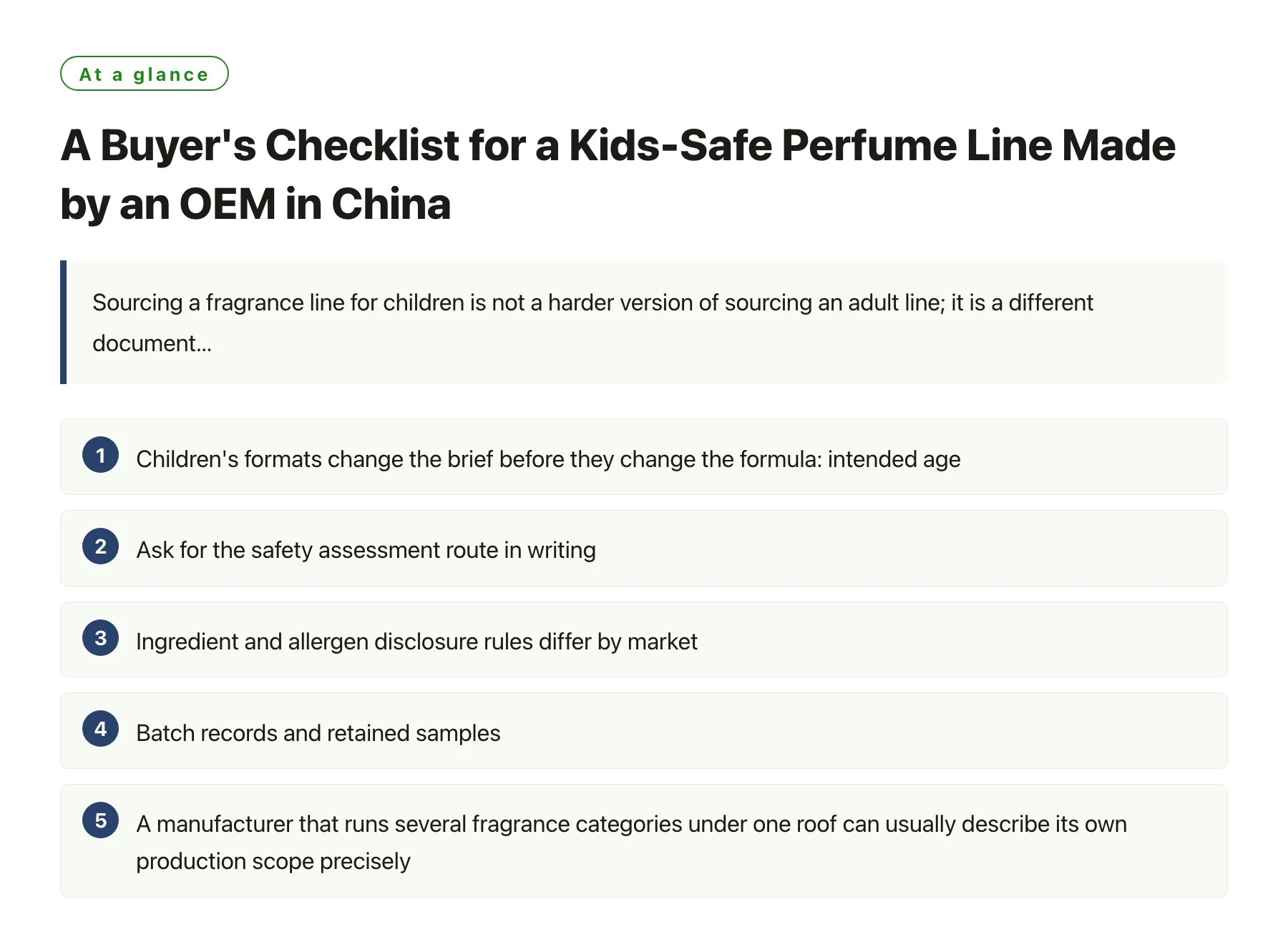
Key takeaways
- Children's formats change the brief before they change the formula: intended age, application area and frequency of use determine which safety route applies.
- Ask for the safety assessment route in writing, including who prepares it and which data it relies on.
- Ingredient and allergen disclosure rules differ by market, so the back panel should be drafted from the destination market's requirements rather than copied from a domestic version.
- Batch records and retained samples, not certificates, are what let a buyer demonstrate that a shipped lot matches the approved reference.
- A manufacturer that runs several fragrance categories under one roof can usually describe its own production scope precisely, which makes two quotations genuinely comparable.
Most brands arrive at this project with a formula request and a target cost. Both are reasonable, and both are premature. For a product used by or near children, the specification is what creates the cost, and the specification is almost never written down at the start.
The good news is that the missing work is short. A one-page intended-use statement, a named safety assessor, a label drafted to the right market's rules and an agreed traceability routine cover most of the exposure. Each of them is cheap to fix before sampling and expensive to fix after tooling.
What follows is the order in which an experienced buyer usually works through it, and the answers that should raise a question rather than close one.
What actually changes when the user is a child
A fragrance for a younger user is usually a simpler, lower-dosage formula in a format applied often: a light body mist, a hair and body spray, a scented bath product, a linen or room scent in a child's bedroom. That combination, not the word on the pack, is what drives the paperwork. Cosmetic rules are built around the intended user, the part of the body the product touches and how frequently it is applied, so the first genuinely useful document is not a certificate at all. It is a written statement of intended use [1].
This is also where briefs most often fail. A brand sends three lines, the factory quotes a standard base, and the safety assessment has to be reworked later because the age band was never fixed. Decide the age band, the application area and the daily use pattern before sampling. Every later cost, including the cost of a second sampling round, hangs off those three answers.
The formula is the smaller half of the problem
Fragrance houses assess a submission against the standards that apply to a defined product category, and those categories are separated by the way a product is used rather than by how it smells [2]. Ask the perfumer which category the formula is being assessed under and have that recorded. A base that performs well in a hand cream is not automatically suitable for a product a small child sprays close to the face.
Concentration is a symptom, not a strategy
Lower concentration is common in children's formats because it reduces exposure and because a lighter scent is often what parents prefer. Treating a low percentage as the safety answer misses the point: the assessment looks at the whole formula, the packaging and the way the product is used. A low-dosage product in a poorly chosen pack can raise more questions than a well-documented standard one.
The checklist, item by item
| Checkpoint | What to ask | Evidence a strong supplier offers |
|---|---|---|
| Intended use statement | Age band, application area, frequency of use | A one-page specification the safety assessor can work from directly |
| Safety assessment route | Who prepares the report, and which data it depends on | A named assessor, listed data sources, and a date attached to the version |
| Ingredient and allergen disclosure | Which ingredients must appear on the label in each destination market | A label draft built from the destination market's rules and checked against the ingredient database |
| Microbiology and stability | What testing is done on the finished product, and at which stage | Test scope, the laboratory used, and the specific lot the result refers to |
| Batch traceability | What links a shipped unit back to the approved reference | A completed batch record from raw material intake to release, plus a retained sample held by both parties |
Two of those five are commercial rather than technical: the intended use statement and the traceability agreement. They are also the two buyers most often skip, and the two that are hardest to reconstruct once the first order has shipped.
The order that saves the most money
- Write the intended-use statement firstOne page covering age band, body area, format and frequency. Everything downstream, including the brief, is a consequence of this page.
- Send identical wording to every candidateCompare the answers line by line before comparing price. A published question set such as what to check before choosing a perfume factory is a reasonable starting point, provided every supplier receives exactly the same wording.
- Ask for one completed batch recordNot a blank template and not a certificate, but a record from a lot that actually shipped. It is a small and honest picture of how the plant works.
- Draft the label before the artworkDisclosure requirements decide how much space the back panel needs. Designing the pack first often means redesigning it after the first compliance review.
- Agree the retained sample routineSealed, dated, batch-numbered and held by both sides. It turns a later disagreement about smell or colour into a measurement rather than an opinion.
Where a kid-safe line hides its extra cost
A narrower palette and a lower dosage give the perfumer less room to disguise a weak base, so revisions tend to run longer than on a standard adult brief. Sampling is usually billed by round, which is why the brief is worth two extra days of work at the start. Ask how many revision rounds are included and what a fourth or fifth round costs before you sign.
Packaging is the second layer. Closure choice, small detachable parts, dosing format and the age-grading of the pack itself are compliance decisions before they are design decisions, and they vary by destination market. A buyer who treats packaging as a decoration item will discover this at the artwork approval stage, when the schedule is least able to absorb it.
Buyers who have not produced in the region before usually start with a search for perfume manufacturer China, and the directories that come back list hundreds of profiles that look almost identical. The screening question that separates them is rarely capacity. It is whether the supplier can name the person responsible for the safety documentation and describe that process in their own words rather than in a template email.
Long-established factories in Guangzhou publish their service scope and certification list openly. Xuelei, for example, describes itself as a Guangzhou fragrance manufacturer with 31 years in the category. That does not make any single supplier the right partner, but it does give a buyer something concrete to verify against, which is more than a directory listing offers.
One roof, or several hands
The practical filter that follows is scope. Fragrance development, bottle and packaging design, filling, packing and testing can all sit inside one plant, or they can be spread across four companies that each invoice separately. When they are spread out, every compliance question acquires a handover, and a handover is where a document quietly goes missing.
For a children's line that matters more than usual, because the safety file has to describe the product as it is actually made. Ask each candidate to list the steps it performs itself and the steps it buys in, with no subcontracted work folded into the general description. A partner offering custom fragrance R&D and production end to end will normally answer that in one list, and a comparable list from a second supplier makes the two quotations genuinely rankable.
Neither structure is automatically better. An integrator is simpler to audit and easier to hold to a date; a specialist network can be cheaper on a narrow, unusual brief. What a buyer cannot afford is discovering which one they chose after the deposit has been paid.
The most common failure on a children's line is not a bad formula. It is a project where the intended use was never written down, so the safety assessment, the label and the packaging brief were all built on assumptions that nobody has since checked. Put the age band, the application area, the assessor's name and the retained sample routine on a single page and have both sides sign it. Those four lines survive every later change to the product.
Sources
- European Commission: Cosmetics in the EU —— The European Commission's overview of EU cosmetics rules, including the responsible person, product information file and safety report requirements.
- IFRA Standards Library (International Fragrance Association) —— The IFRA Standards Library lists the restrictions the fragrance industry applies to individual fragrance ingredients, based on safety assessments; it is the reference point for compliant fragrance formulation.
Frequently asked questions
Is a children's fragrance line regulated differently from an adult one?
The rules are usually the same framework applied more carefully. What changes is the exposure assessment, the evidence the assessor expects, and how strictly labelling and claims are read in the destination market. Confirming the intended age band in writing is the step that makes the difference visible.
Do I need a separate safety assessment for each country I sell in?
The assessment is prepared for a product and for the rules that apply where it is sold, so the same formula may need market-specific paperwork. Ask your importer or regulatory consultant which markets accept a shared assessment and which require their own before you print labels.
What sets the minimum order for a kids-safe fragrance?
Often the bottle or the closure, not the juice. Component tooling and decoration runs have their own minimums, so ask for the MOQ of the fragrance, the bottle, the cap and the decoration as separate lines rather than as one blended figure.
How many sample rounds should we budget for?
Two revisions is a realistic planning number for a first children's brief, with a third if the palette is unusual. Ask what each additional round costs and whether it is quoted per version or per shipment of samples.
Can the same formula be used for a children's product and an adult product?
Technically it can, but the assessment and the labelling are tied to the intended use, so the same liquid sold under two different use statements is two documentation jobs. Keep the formulations distinct if the positioning is distinct; it is cheaper than explaining the overlap later.